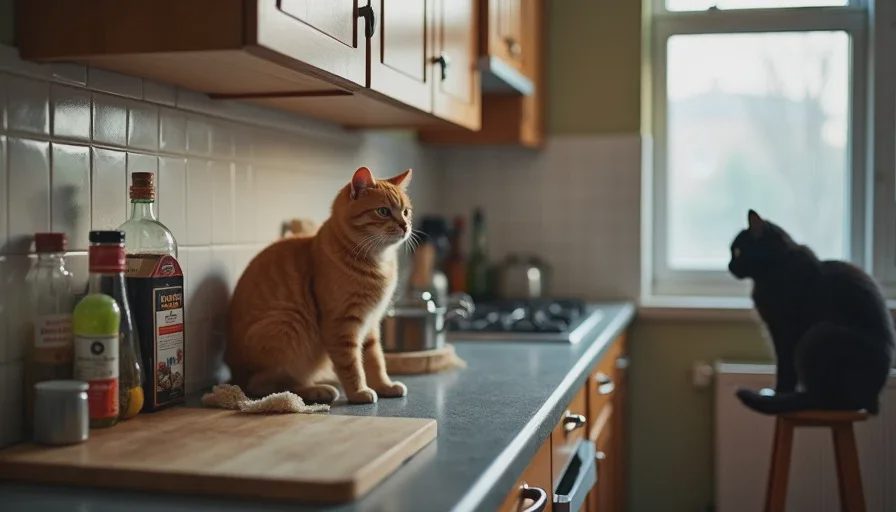
Dinner in this apartment is a spectator sport.
I start by clearing a working section of the counter. Within ninety seconds at least one cat is occupying the cleared space. Sometimes two. On ambitious nights all three appear, arranged at different elevations like a panel of slightly judgmental reviewers. The stove is not safe. The cutting board is not safe. The edge of the sink is a preferred observation post. Any attempt to enforce a “no cats on the counter while cooking” rule lasts approximately the length of time it takes to wash a single vegetable.
This is not a failure of training. It is the predictable outcome of living with three animals who consider vertical surfaces public property and food-preparation smells a form of entertainment.
The Cast and Their Preferred Roles
Miso claims the highest available point near the action. If the top of the refrigerator is accessible, he takes it. If not, he settles for the far end of the counter where he can watch without being easily moved. His contribution is pure surveillance. He rarely reaches for food. He simply records the process and occasionally steals from any glass of water left within range.
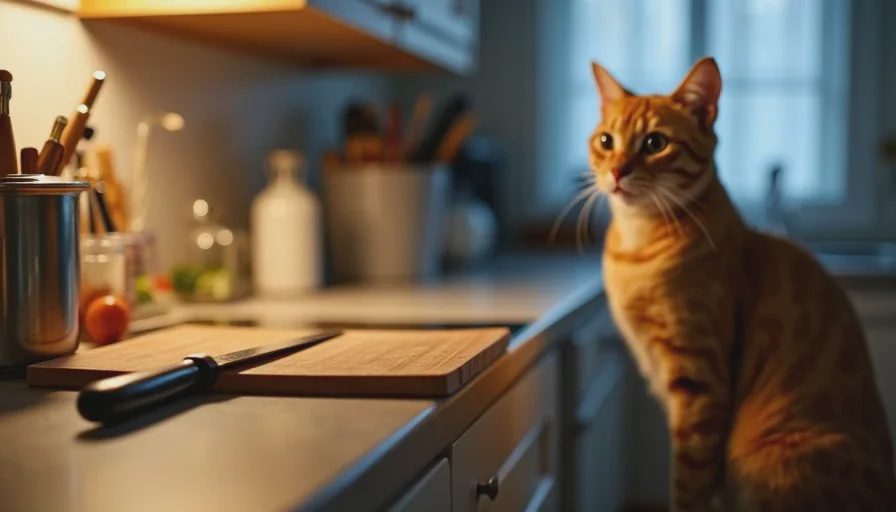
Nori appears later and more cautiously. She prefers the stool or a chair pushed near the counter rather than the counter itself. From there she can monitor without committing to the high-traffic zone. If the kitchen becomes too chaotic she retreats to the doorway and continues the observation from a safer distance. Her presence is quieter but consistent. She is the reviewer who never leaves a comment but clearly has opinions.
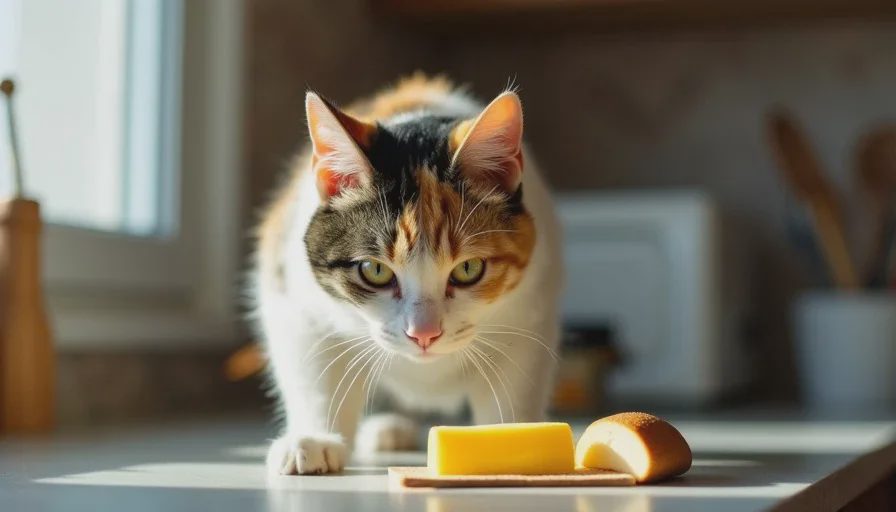
Dumpling treats the entire kitchen as an interactive exhibit. She jumps onto the counter with full confidence, investigates every ingredient, and will absolutely attempt to sample anything left unattended for more than three seconds. Butter, cheese, the occasional piece of cooked chicken, and once a stick of butter still in its wrapper have all required rescue. She is the reason the “turn your back for one moment” rule exists.
Why the Counter Wins Every Time
Cats like height. Counters are high, stable, and located in the room where interesting smells and sounds concentrate. Add the warmth of a recently used stove, the sound of running water, and the possibility of dropped food, and the surface becomes more attractive than most of the approved perches in the apartment.
Punishment does not solve this. A spray bottle or a raised voice may clear the counter for thirty seconds. It also teaches the cats to wait until you are not looking. The behavior returns the moment supervision lapses. More useful approaches are environmental: give them legal high places near the kitchen, remove the most tempting rewards, and accept that complete victory is unlikely.
I keep a sturdy stool and a low cat tree within sight of the cooking area. Sometimes they are used. Sometimes the counter still wins. The goal has shifted from total exclusion to reducing the frequency of direct interference with the food itself.
Practical Tactics That Partially Work
Clear a dedicated workspace and defend only that zone. Trying to keep the entire counter sterile is exhausting and usually fails. A smaller, actively used section is easier to manage.
Prep ingredients that are especially attractive (cheese, meat, anything buttery) in shorter bursts and return them to the refrigerator between steps. The longer a high-value item sits out, the higher the odds of an investigation.
Give the high-energy cat a short play session or a food puzzle before starting dinner. A slightly tired Dumpling is less committed to counter surveillance.
Accept that some nights the most efficient path is to work around the audience rather than against it. Move the cutting board. Use a different section of counter. Let Miso keep his observation post as long as he stays out of the active prep area.
Wash produce and wipe surfaces more often than a cat-free kitchen would require. This is not optional. Cats walk through litter boxes and then jump onto the same surfaces where food is prepared. The cleaning step is part of the process.
The Nightly Scoring System
Unofficial points are awarded as follows:
Successful theft of an unattended ingredient: Dumpling, three points
Maintaining the highest observation post for the entire cooking session: Miso, two points
Remaining present but never actually touching the counter: Nori, one point and quiet respect
Human managing to plate a complete meal without major incident: one point, rarely celebrated
Most nights the cats win on points. The human wins on calories. The arrangement is stable enough that it has become background rather than crisis.
What the Counter War Actually Teaches
Living with cats means sharing vertical space whether you planned to or not. The kitchen is simply the room where the contest is most visible and most inconvenient. Fighting the fundamental preference for height and proximity to interesting activity consumes more energy than it saves. Designing around it — legal perches, faster handling of high-value foods, realistic expectations — produces a quieter evening.
I still clear a working section of counter every night. I still move cats when they step directly into the prep area. I still lose small items of food to opportunistic sampling. The difference is that I no longer treat the presence of the panel as a personal failure or a solvable problem. It is simply the condition under which dinner happens in this apartment.
Some nights one of them will decide the show is over and leave early. Some nights all three remain until the last dish is washed. On the best nights the food turns out well anyway, the counters get wiped, and the judges disperse to their evening stations. That is as close to a clean win as the situation allows.
Your cat, your rules. Even when the rules include supervising the cook.



Letters
No letters yet. Yours could be the first.