Miso had been the only cat for years. Then Nori arrived and eventually stayed. By the time Dumpling came home, Miso had already decided the household hierarchy was settled. A young, bouncing calico who treated every hallway as a racetrack was not part of the plan.
The first visual meeting lasted less than ten seconds. Miso puffed, hissed, and planted himself in the doorway like a security guard. Dumpling, undeterred, tried to charge forward. I closed the door and started over.
This is the thirty-day structure that eventually worked. It is slower than most people want and faster than giving up. Adjust the timeline if either cat shows prolonged stress, stops eating, or begins marking. The cats set the real pace. The calendar just keeps you honest.
The thirty-day structure
Days 1–7: Complete Separation and Scent Work
Keep the new cat in a dedicated room with everything she needs: litter box, food, water, hiding spots, scratching surface. The resident cat keeps the rest of the apartment.

Daily tasks:
Swap bedding or towels between the two spaces so each cat smells the other without seeing them.
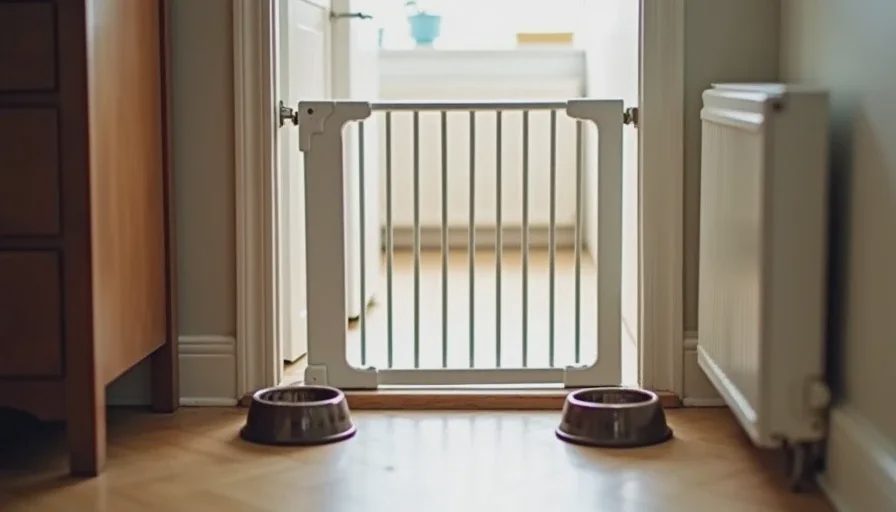
Feed both cats on opposite sides of the closed door at the same times. Start a few feet away and gradually move the bowls closer to the door over the week if both continue eating normally.
Sit in the new cat’s room for short, quiet periods so she associates the space with calm human presence.
Maintain the resident cat’s routine as closely as possible. Extra play or attention helps offset the disruption.
Watch for stress signs on both sides: reduced appetite, hiding more than usual, over-grooming, or litter box avoidance. If either cat stops eating for more than a day, pause and give more time at this stage.
Miso spent the first three days sniffing under the door and then walking away with his tail low. Dumpling cried at the door for the first two nights and then settled into exploring her room. By day six both were eating with the bowls near the door. That was the green light to continue.
Days 8–14: Visual Access Without Contact
Install a barrier the cats can see through but not cross — a baby gate (stacked if needed), a screen door, or a door cracked open with a sturdy obstacle. Supervised sessions only.
Start with short periods: five to ten minutes, two or three times a day. Feed them on opposite sides of the barrier so the sight of the other cat pairs with something positive. End the session before either cat escalates. Hissing and staring are common at this stage. Lunging, sustained growling, or attempts to push through the barrier mean the session is too long or too soon.
Continue scent swapping. Let each cat explore the other’s space while the other is confined elsewhere (room swaps). Keep these short at first.
In our case Miso spent most of the visual sessions staring and occasionally growling. Dumpling treated the gate like a puzzle to solve. I ended sessions the moment Miso’s tail started lashing hard. Progress was measured in the absence of full-blown attacks, not in friendship.
Days 15–21: Short Supervised Time in the Same Space
When both cats can eat calmly near the barrier and show more curiosity than hostility, allow brief shared time in a larger room. Keep the new cat’s safe room available as a retreat.
Use a leash or harness on the more reactive cat if needed, or simply stay close enough to intervene. Have a large towel or piece of cardboard ready to block line of sight if tension rises. Do not punish either cat for hissing. Redirect with a toy or calmly separate them and try again later.
Keep sessions short — ten to fifteen minutes — and always end on a neutral or positive note. Increase length only when both cats can share space without constant vigilance.
Miso’s breakthrough came when Dumpling stopped charging and started playing with a wand toy at a distance. Miso watched from a chair. He still did not approach, but he stopped blocking every doorway. That shift mattered more than any forced proximity.

Days 22–30: Gradual Free Access with Supervision
If the short sessions are mostly calm, begin leaving them together for longer periods while you are home and able to watch. Continue providing multiple resources: extra litter boxes, separate feeding stations, multiple elevated perches, and distinct resting spots so neither cat feels forced to share.
Do not leave them unsupervised overnight or while you are out until you have seen consistent peaceful coexistence for several days. Even then, keep the original safe room set up for a while longer.
By day thirty Miso and Dumpling were sharing the main living areas without incident most of the time. They were not friends. They were functional roommates. Miso still claimed the highest perch and occasionally swatted when Dumpling got too close to his food. Dumpling learned the boundaries and found other places to be chaotic. That was success.
What the Plan Does Not Guarantee
Some cats become bonded. Many simply learn to tolerate each other. A few never share space comfortably no matter how carefully you introduce them. If after several weeks of consistent work the aggression remains high, one cat is chronically stressed, or medical issues appear, it is reasonable to reassess whether the household can support both animals long-term.
Resources matter as much as the introduction timeline. Extra litter boxes, vertical space, and separate feeding areas reduce the daily friction that can undo careful introductions.
Miso never became Dumpling’s mentor. He did, however, stop treating her as an invader. The thirty-day structure gave both of them enough controlled exposure to rewrite the first bad impression. It also gave me a clear framework instead of guessing when to open the next door.
If your oldest cat has decided the newcomer is not welcome, start with separation and scent. Move only when the current step is calm. Keep more resources than you think you need. And accept that “getting along” often looks quieter and less affectionate than the internet videos suggest.
Your cat, your rules. Even when there are suddenly more of them.



Letters
No letters yet. Yours could be the first.