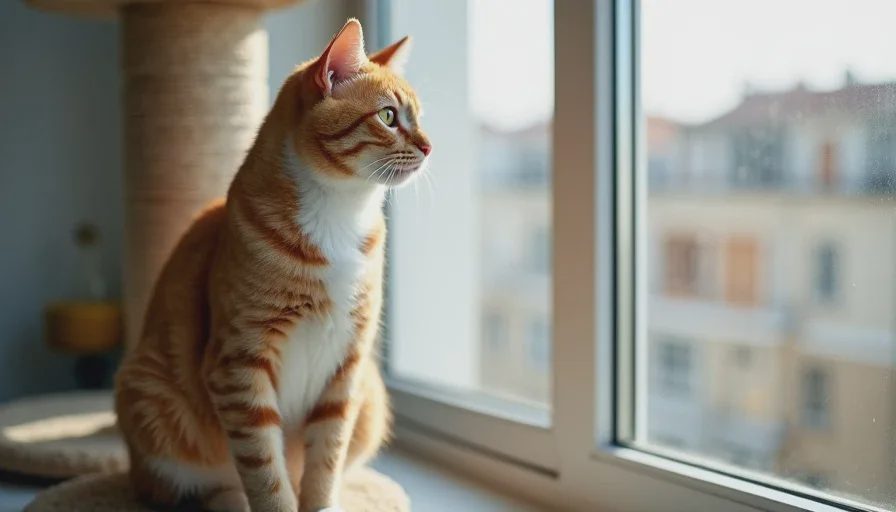
Miso arrived half-starved and one-eyed. He was not supposed to stay. Nine years later he is the permanent senior resident, the one who inspects every new foster, claims the highest available surface, and runs a quiet but consistent management system over the rest of the household.
He is not a trained supervisor. He is an orange tabby with strong preferences and a long memory. Living with him has been more educational than most of the behavior books I have read. The lessons are not abstract. They are repeated daily in small, observable decisions. What follows is the unofficial rule set that has emerged from nine years of watching him operate.
Miso’s Five Rules
Rule 1: The Highest Point Is Not Optional
Miso claims elevation the way some cats claim a favorite chair. The top of the cat tree, the highest shelf, the back of the couch when nothing higher is available. From those positions he can see the entire main room, monitor doorways, and decide whether a situation requires intervention.
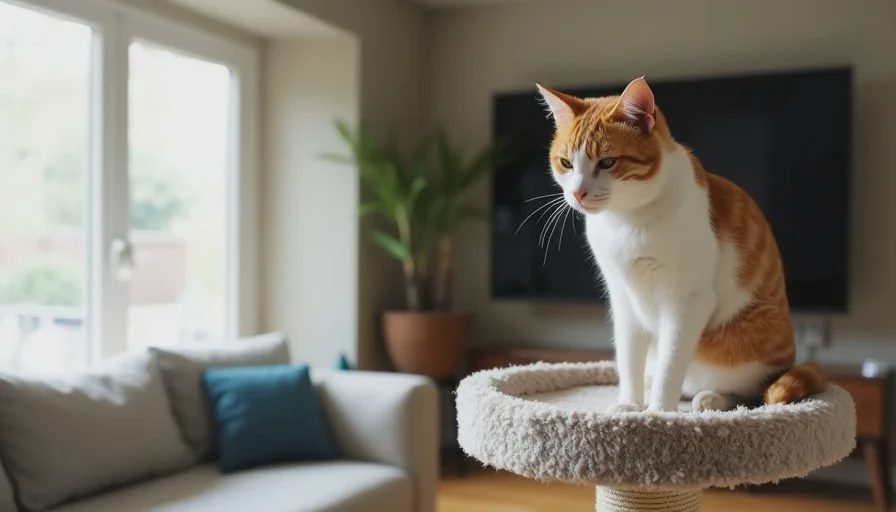
In practical terms this taught me that vertical space is not enrichment decoration. It is infrastructure. When the highest points are limited, the most confident cat controls the visual field and the more sensitive cats lose a key safety option. Adding more elevated surfaces reduced tension more effectively than most of the pheromone products I tried in the early years.
New fosters learn quickly that the top tier is occupied. Most of them stop competing for it within a few days. The ones that keep trying receive a single, efficient swat and then a return to watching. The message is consistent.
Rule 2: Water Belonging to Humans Is Superior
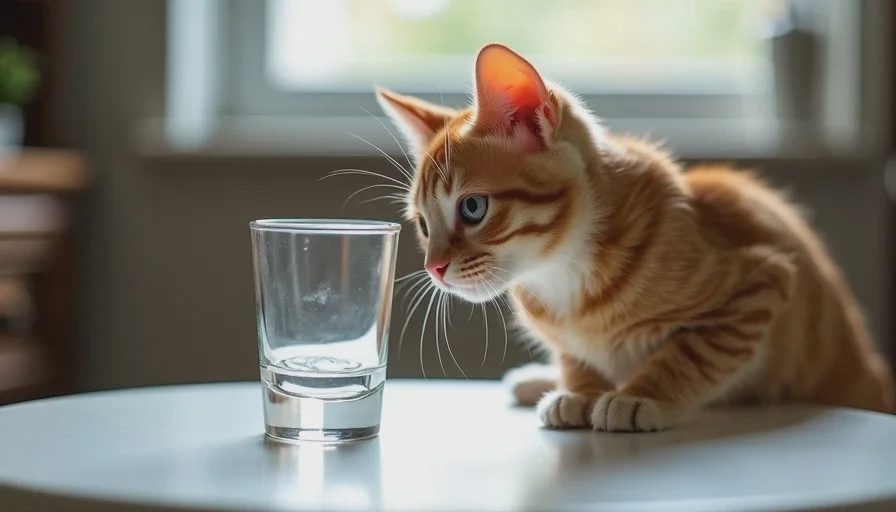
Miso steals water from every glass left unattended. He has done this since recovery. Bowls of fresh water sit in multiple locations. He walks past them to investigate the cup on the side table. The behavior is reliable enough that I now move glasses as a reflex.
I used to treat it as a quirk to be discouraged. Over time it became data. Preference is not always logical from the human side. If a cat repeatedly chooses one water source over another, the chosen source is the one that matters. Fighting the preference wastes energy. Managing it — using cups with lids, placing them out of reach, or accepting the occasional theft — is more efficient.
The same principle applies to other resources. The litter box a cat actually uses is more important than the one that looks best in the room. The resting spot that gets occupied is the real one, regardless of how expensive the unused bed was.
Rule 3: New Cats Receive a Formal Inspection
Every foster that enters the apartment receives a structured assessment from Miso. He approaches, sniffs, stares, and then delivers a verdict. Some cats are immediately categorized as irrelevant and ignored. Others receive ongoing low-level monitoring. A few trigger repeated intervention.
He does not perform this ritual for entertainment. It is information gathering. Once the inspection is complete, his behavior becomes predictable. He is not randomly aggressive. He is selectively managerial. Understanding that difference changed how I timed introductions and how long I kept new cats separated.
The practical takeaway is that resident cats often have better real-time data about a newcomer than the human does. Watching the senior cat’s response — curiosity, dismissal, sustained tension — gives useful signals about how much management the new placement will require.
Rule 4: Direct Approaches Are Rude
Miso rarely runs at another cat. He positions, waits, and controls access points. When Dumpling charges through a room, Miso does not match the energy. He claims a chokepoint or simply occupies the space the younger cat wanted. The effect is the same: the chaotic movement is interrupted without a full fight.
This style is more effective than matched intensity. Matching an energetic cat’s arousal usually escalates the situation. Occupying key resources and pathways reduces the payoff of the chaotic behavior. I started copying the approach — redirecting Dumpling with a toy or a temporary barrier instead of chasing or scolding — and the daily friction dropped.
Nori, the most sensitive of the three, benefits from the same logic. She is given clear exit routes and elevated options so she can remove herself without a confrontation. Miso’s spatial control created a template for how to design the apartment so that avoidance is easy and conflict is expensive.
Rule 5: Consistency Outranks Intensity
Miso does not need to make a large demonstration every day. His rules are enforced the same way each time. The top perch remains his. The water glass remains interesting. New cats remain subject to inspection. Because the patterns are stable, the other cats spend less energy testing them.
Inconsistency is what creates ongoing negotiation. When the human rules change with mood or convenience, the cats keep checking for updates. Miso’s predictability is a form of quiet authority. The household runs more smoothly when the important boundaries are equally boring and reliable.
This is the rule I have borrowed most heavily. Feeding times, play sessions for the high-energy cat, protected quiet zones for the sensitive one, and the basic resource layout stay as consistent as the schedule allows. The cats spend less time monitoring me for surprises and more time settling into their own patterns.
What Nine Years of Observation Actually Yields
Miso is not a therapist or a role model. He is a specific animal with a specific history who has been given enough time and space to show how he prefers to organize his environment. Watching him has been more useful than trying to impose an abstract ideal of multi-cat harmony.
The oldest cat in a household often holds useful information. He has seen the introductions that worked and the ones that failed. He has adjusted to the permanent residents and the temporary ones. His current behavior is the compressed result of that experience. Ignoring it in favor of generic advice is a missed opportunity.
None of this means every senior cat should be allowed to dictate terms without limit. It means the data they provide is worth collecting. Where does the oldest cat choose to sit? Which pathways does he control? Which newcomers does he dismiss and which ones does he continue to track? Those observations are practical inputs for how to arrange space, timing, and resources.
Miso still steals water. He still claims the highest point. He still performs his inspections. The apartment has been shaped around those facts rather than in opposition to them. The result is not perfect peace. It is a working system in which three very different cats can meet their needs without constant escalation.
Nine years is long enough to stop treating the senior cat’s logic as an obstacle and start treating it as information. The orange tabby who almost died in a carrier has become the most reliable source of multi-cat management data in the house. I no longer argue with the rules. I take notes.
Your cat, your rules. Especially the ones the oldest cat has already written.


Letters
No letters yet. Yours could be the first.