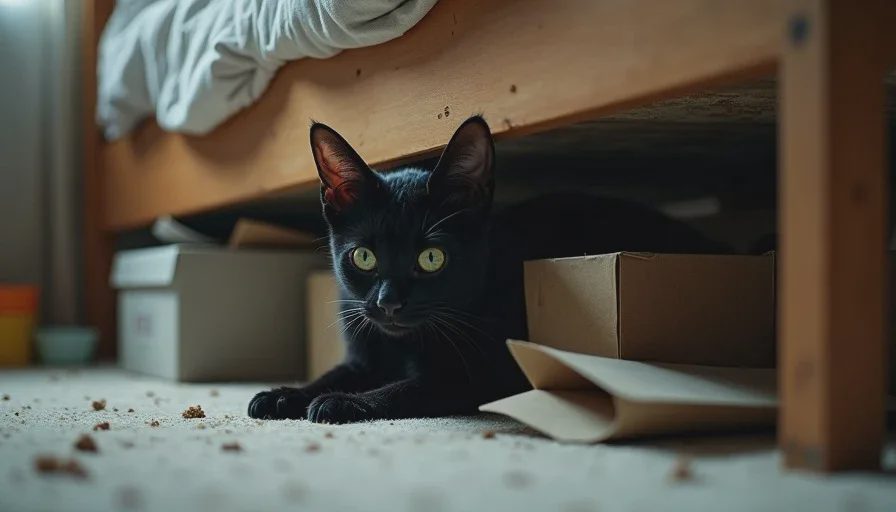
Nori arrived in a carrier that smelled like stress and other cats. She was a pure black Devon Rex, maybe a year old, surrendered from a small breeding setup that had shut down. The notes said she was “shy” and “needs a quiet home.” That was an understatement.
I set up the usual foster room: litter box, food, water, a covered bed, the open carrier with a towel. I opened the door and stepped back. She shot out like something was chasing her and vanished under the bed in the main bedroom. I did not see her again for three days except for the occasional shift of shadow when I checked the food dish.
Most fosters take a few days to a couple of weeks to decompress. Nori took the concept seriously.
Lived under that bed
The First Month: Invisible Roommate
I kept the bedroom door open so she could access the litter box and food without crossing open space if she did not want to. I placed the dishes just outside the bed frame. Every morning the food was gone and the litter box had been used. That was the only evidence she existed.
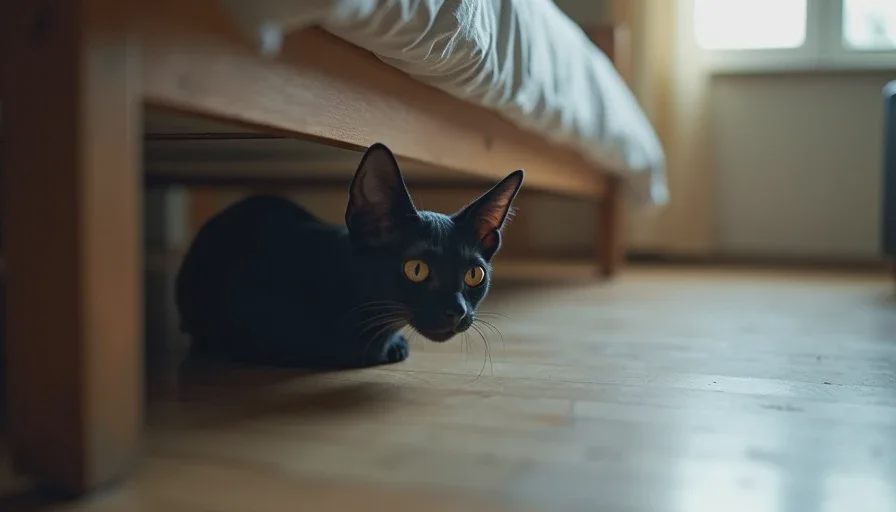
I sat on the floor near the bed and read work emails out loud in a normal voice. No baby talk. No reaching under the frame. No flashlight checks. Just the sound of a human existing nearby without demanding anything. Some days I left a few pieces of freeze-dried chicken at the edge of the bed and walked away. Some days the chicken disappeared. Some days it did not.
Devon Rex cats are often described as social, mischievous, and people-oriented. Nori had the large ears and the soft wavy coat, but the personality had been shaped by whatever the breeding environment had been. She treated every sudden movement as a potential threat. Eye contact made her freeze. The sound of a plastic bag sent her deeper into the shadows.
I stopped inviting people over. I moved my work setup into the living room so the bedroom stayed quiet. Miso, already the senior resident, inspected the bed once, decided the new arrival was not his problem, and went back to stealing water from glasses. That was the extent of the introduction for a long time.
Month Two: The First Real Sightings
Around week six she started appearing in the doorway of the bedroom when the apartment was silent. Just a black shape with oversized ears, staring. If I turned my head she vanished. If I stayed still and kept talking to the laptop she stayed a little longer each time.
I began leaving the freeze-dried chicken farther from the bed, then on a low stool, then eventually on the floor near where I sat. The first time she came all the way out to take a piece while I was in the room I did not move. I did not speak. I let her take it and retreat. That single transaction felt like a contract signed in very small print.
Progress was not linear. A loud truck outside could erase three days of tiny gains. A new foster arriving in the other room set her back a full week. I learned to schedule everything around her tolerance. No vacuuming near the bedroom. No sudden rearranging of furniture. The goal was not to make her bold. The goal was to make the environment predictable enough that boldness became possible.
Month Three: Consent in Real Time
By the end of the third month she would sit on the bed while I worked in a chair a few feet away. She still flinched if I stood up too quickly. She still preferred the underside of the bed as her primary address. But she had started sleeping in a loaf on top of the covers at night when the lights were off.
The first time she climbed into my lap it was entirely her decision. I was sitting on the floor sorting laundry. She approached from the side, sniffed my knee, and settled. I kept my hands still for a full minute before resting one lightly on her back. She stayed. That was the moment I knew she was not leaving.
Foster fail number two. The shelter coordinator was not surprised. Some cats need a home that will wait them out instead of pushing them forward on a timeline.

What Actually Worked
Never forced contact. Reaching under the bed or pulling her out would have destroyed whatever thin trust existed.
Food as the only currency at first. High-value, small amounts, always left rather than offered from a hand until she was ready.
Predictable human presence without pressure. Reading emails, working quietly, existing in the same space.
Respect for the hiding place. The under-bed territory stayed hers for as long as she needed it.
Slow expansion of the safe zone. First the bedroom, then the hallway, then the rest of the apartment on her schedule.
What did not work: catnip, laser pointers, recorded bird sounds, pheromone sprays as a primary strategy, or any attempt to “show her it was safe” by handling her. Those tools can help some cats. They made Nori more certain that the world was unpredictable.
Who She Is Now
Nori is five. She is still the most sensitive of the three. Loud guests send her under the bed or into the closet. She is selective about which fosters she tolerates. She has never become the shoulder-riding, constantly vocal Devon Rex of breed descriptions. She is something quieter and more precise.
She sleeps under the covers against my legs most nights. She climbs into the hood of my sweatshirt when she wants to be carried. She slow-blinks from across the room when she is feeling brave. She still startles at sudden noises, but she recovers faster than she used to. When she chooses to sit near me it feels earned every time.
The three months under the bed taught me more about consent than any training manual. A cat who hides is not broken or spiteful. She is collecting data. Your job is to make the data consistently boring and safe until she decides the experiment can continue.
I still leave the occasional freeze-dried chicken on the floor near the bed even though she has not lived under there for years. Old habits. Small offerings. Proof that the contract still holds.
Your cat, your rules. Especially when the cat is still deciding whether the rules include you.



Letters
No letters yet. Yours could be the first.